


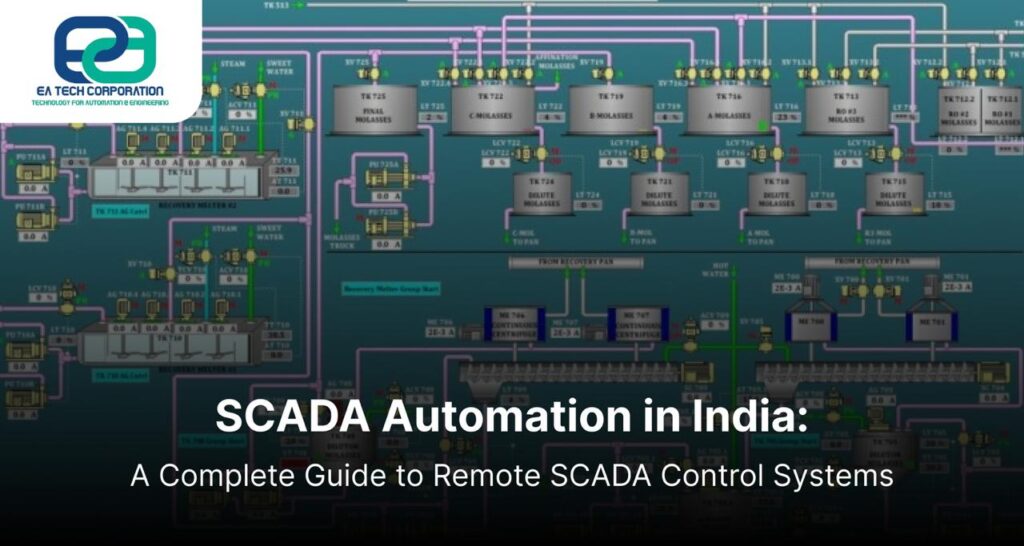
India is rapidly evolving with the adoption of advanced automation technologies, and so is the industry sector. EA Tech Corporation’s SCADA automation in India has become one of the backbones of the modern infrastructure. SCADA enables real-time monitoring, remote control, and intelligent decision-making, and now, with the help of Industry 4.0, remote SCADA control systems are helping Indian industries operate more efficiently, reduce downtime, and improve safety.
What is SCADA and How Do Remote Systems Work?
SCADA, a combination of hardware and software, helps monitor and control industrial processes in real time. It involves a process of collecting data from sensors and field devices, processing the information, and displaying it through centralized dashboards for operators.
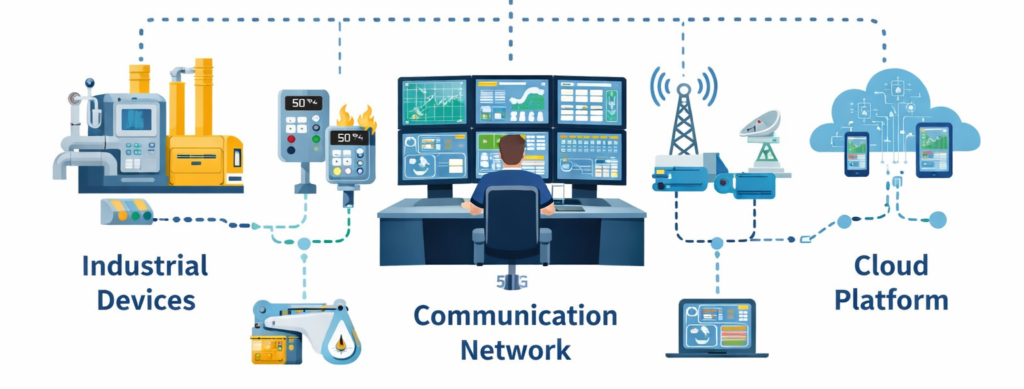
With the help of the communication network, cloud platforms, and control rooms, Remote SCADA control in India allows the engineers to monitor and manage equipment from distant locations. This is extremely helpful for power grids, pipelines, and water treatment plants, as with SCADA, they get faster responses to faults, predictive maintenance, and continuous performance monitoring.
Key Components of Remote SCADA Control
SCADA control systems companies in India typically consist of:
- Remote Terminal Units (RTUs) & PLCs: Deployed in the field to collect, process, and store field data, transmitting it to the master station.
- Human-Machine Interface (HMI): Allows operators to monitor processes, view alarms, and send commands to remote equipment, all by presenting data in a graphical format.
- Communication Infrastructure: The network connecting remote sites to the control center, with the help of radio, cellular, fiber optics, or Ethernet, to facilitate data transfer
- Security and Authentication: Protection of the system from cyber threats and unauthorized access, with the help of firewalls and encryption.
Benefits of SCADA Automation
Implementing SCADA automation in India has multiple benefits attached to it. Some of them are:
- Real-time monitoring and control: Operators can detect issues and take required action in an instant.
- Improved operational efficiency: Less manual intervention, improved output.
- Reduced downtime and maintenance costs: No more unexpected equipment failures, thanks to predictive maintenance.
- Enhanced safety and compliance: Minimizes hazards and ensures regulatory compliance through continuous monitoring.
- Data-driven decision making: Better productivity and energy efficiency through advanced analytics.
Challenges and Their Solutions
| Challenges | Solutions |
|---|---|
| Security Risks | Implement strong cybersecurity frameworks and encrypted communication. |
| High Initial Investment | To reduce costs, adopt modular or cloud-based SCADA solutions. |
| Technical Complexity | Ensure employees are properly trained and equipped with the right technical knowledge. |
| Integration with Legacy Systems | Use open communication standards to simplify system integration. |
You will get all these solutions at one place, EA Tech Corporation, which will help you to focus on other precious activities and let us handle the rest.
Statistics
- As per Imarc group, India’s SCADA market reached USD 766.5 million in 2024 and is expected to reach USD 1.28 billion by 2033.
- Cloud-based SCADA systems are projected to grow at the fastest rate.
- The SCADA market in India is experiencing strong growth, with an estimated CAGR of 8.7% to over 12% projected through 2030-2034.
Conclusion
The continuous evolution of industrial operations made SCADA automation in India all about taking control into your own hands. With the growing complexity and intricacy of infrastructure, EA Tech Corporation, with its Remote SCADA control in India, is here to solve all your worries related to industrial processes.
FAQs
- Power generation, water treatment, oil and gas, manufacturing, and smart infrastructure are some of the industries in which SCADA is widely used.
- Yes. Cloud-based and modular SCADA solutions make it more affordable and scalable for SMEs.
Real-time monitoring, reduced downtime, improved efficiency, predictive maintenance, and enhanced safety are some of the benefits of SCADA automation.