


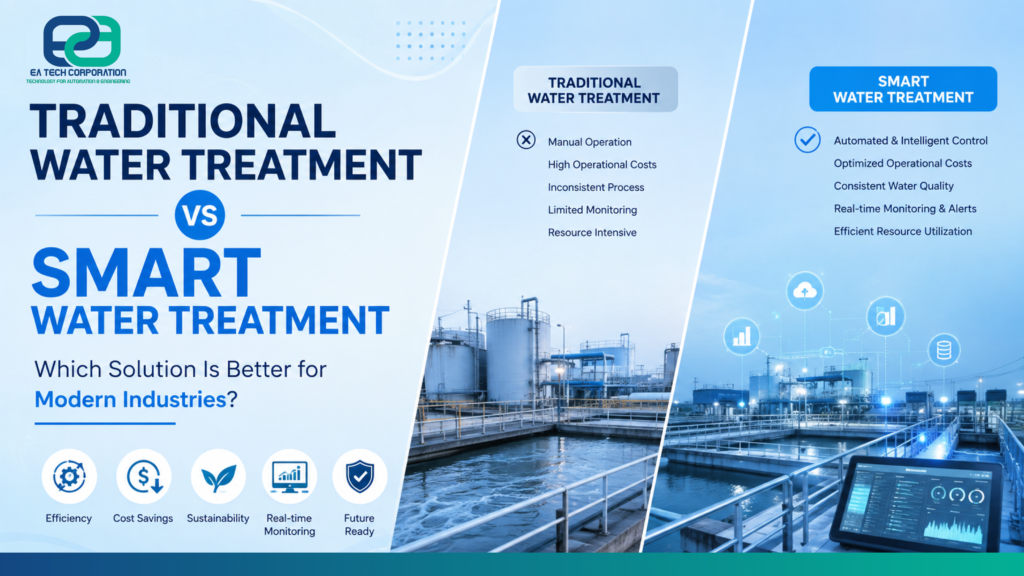
Water is one of the most important resources for homes, industries, businesses, municipalities, and communities. But as water quality challenges increase and industries become more conscious about operating costs, sustainability, and regulatory requirements, simply treating water is no longer enough. Businesses increasingly need efficient water treatment systems, better monitoring, lower operating costs, and solutions that can adapt to changing water quality and demand.
This is creating an important comparison in the industry: traditional water treatment vs smart water treatment.
Traditional systems can provide effective treatment when properly designed and operated. However, modern water treatment combines treatment technologies with automation, real-time monitoring, IoT, PLC, SCADA, sensors, and data-driven control to improve operational visibility and efficiency.
EA Tech Corporation works across water treatment, wastewater treatment, industrial automation, PLC, SCADA, IoT, and smart infrastructure, providing solutions from design and installation through automation and support. The company states that it serves residential, commercial, and industrial requirements and has more than 13 years of experience.
Why Are Businesses Rethinking Traditional Water Treatment?
A water treatment plant is not simply a machine that removes impurities. Its performance depends on water quality, flow rate, treatment processes, chemical dosing, equipment condition, energy consumption, operator decisions, and regular maintenance.
When these factors are managed manually, several problems can occur.
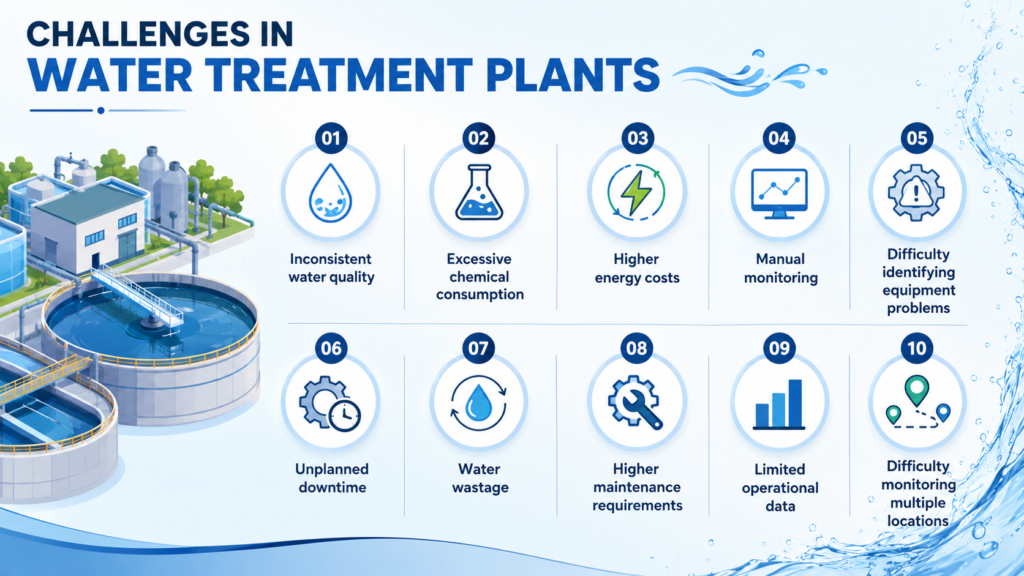
These challenges are encouraging industries and utilities to consider smart water treatment solutions that provide greater visibility and automation.
Traditional Water Treatment vs Smart Water Treatment
Traditional treatment generally depends more heavily on manual operation and periodic checking. Operators inspect equipment, record readings, adjust chemical dosing, and monitor plant performance according to established procedures.
A modern automated water treatment plant can use sensors, controllers, automation panels, PLC systems, SCADA, and IoT technologies to continuously monitor and control important parameters.
The objective is not to remove the operator from the process. Instead, automation gives operators better information and greater control.
A Simple Comparison
| Requirement | Traditional Water Treatment | 💧 Smart Water Treatment |
|---|---|---|
| 01Monitoring | Periodic / Manual | Real-time monitoring |
| 02Chemical Dosing | Manual adjustment | Automated dosing control |
| 03Data Collection | Manual records | Digital data |
| 04Plant Control | Operator-dependent | PLC / SCADA automation |
| 05Equipment Monitoring | Periodic inspection | Continuous monitoring |
| 06Fault Detection | Often reactive | Faster alerts |
| 07Remote Access | Limited | IoT / Cloud-enabled monitoring |
| 08Energy Management | Difficult to optimise | Better operational visibility |
| 09Maintenance | Scheduled / Reactive | Data-supported maintenance |
| 10Scalability | More manual intervention | Easier to automate and expand |
- Water Quality Needs Continuous Attention
Water quality can change depending on the source, season, industrial process, demand, and other factors.
A periodic water-quality check provides information for a particular moment. But continuous monitoring can provide a much clearer picture of what is happening inside a treatment process.
Modern water quality monitoring systems can use sensors and analysers for parameters such as pH, turbidity, pressure, flow, and other process variables.
EA Tech’s product portfolio includes pH analysers, turbidity analysers, chlorine analysers, flow meters, pressure transmitters, level transmitters, and level sensors, supporting more measurable and automated treatment operations.
- Chemical Consumption Can Become a Major Cost
Chemical dosing is an important part of many water and wastewater treatment processes. However, inaccurate dosing can result in unnecessary chemical consumption or inadequate treatment.
Manual dosing can depend heavily on operator experience and periodic measurements.
With automated chemical dosing, sensors and control systems can help regulate dosing more precisely according to process conditions.
EA Tech describes its IoT-enabled chemical dosing approach as supporting precise measurement, automated control, real-time monitoring, and reduced human error.
The goal is not simply to automate dosing. It is to create a more controlled treatment process.
- Manual Monitoring Can Delay Problem Detection
Imagine a pump begins showing abnormal behaviour shortly after an operator has completed a routine inspection.
Without continuous monitoring, the issue may remain unnoticed until the next inspection or until the equipment fails.
With SCADA water treatment automation, operators can monitor plant parameters and receive information about abnormal conditions more quickly.
SCADA can provide a central interface for observing plant operations, while PLC systems can control connected equipment according to programmed conditions.
EA Tech lists SCADA, PLC panel installation and commissioning, VFD control panels, MCC panels, and pump installation and commissioning among its services.
- Energy Efficiency Is Becoming More Important
Pumps, motors, aeration equipment, and other systems can consume significant amounts of energy.
A treatment plant that operates equipment without considering actual demand may use more energy than necessary.
Energy-efficient water treatment involves understanding how equipment operates and identifying opportunities to optimise pumping, flow, pressure, and operating schedules.
Automation and monitoring can provide the information required to understand plant performance and identify inefficiencies.
- Water Treatment Is Moving Towards IoT
One of the most important developments in modern water infrastructure is the use of IoT in water treatment.
IoT can connect sensors and equipment to digital monitoring systems, allowing operational information to be collected and viewed remotely.
For example, flow meters can provide information about water movement, while level sensors can monitor tanks and transmitters can monitor pressure.
EA Tech highlights IoT-based flow-meter data acquisition, real-time data transmission, leak detection, performance optimisation, and remote monitoring as part of its IoT solutions.
This becomes especially valuable when businesses need to monitor multiple treatment systems or locations.
- Wastewater Treatment Requires More Than Disposal
For industries generating wastewater, treatment is not simply about meeting a discharge requirement.
Businesses increasingly want to reduce wastewater generation, control operating costs, improve treated-water quality, and explore water reuse.
An effective Effluent Treatment Plant (ETP) can help industries treat wastewater before discharge or reuse, depending on the process and applicable requirements.
EA Tech states that its wastewater solutions focus on reducing wastewater generation, controlling operating and capital costs, achieving treated-water quality suitable for reuse where applicable, and reducing chemical and energy consumption.
- Automation Can Improve Operational Control
A modern treatment plant may involve pumps, valves, chemical dosing systems, sensors, motors, filters, RO systems, tanks, and multiple treatment stages.
Managing all of these manually can become difficult as plant complexity increases.
Water treatment automation connects these components into a more coordinated system.
PLC systems can control equipment, while SCADA can provide operators with a central view of the process. VFDs can help control motor operation, while sensors provide process information.
This creates a more structured operating environment.
- Choosing the Right Treatment Technology Matters
There is no universal water treatment system that works for every application.
The appropriate technology depends on:
- Raw water quality
- Required treated-water quality
- Flow rate
- End use
- Industrial process
- Wastewater characteristics
- Available space
- Energy requirements
- Operating budget
- Maintenance requirements
- Reuse or discharge objectives
Depending on the application, treatment may involve filtration systems, softeners, disinfection, ETP, STP, chemical dosing, clariflocculation, and other processes.
EA Tech’s current service and product portfolio includes water treatment plants, industrial RO plants, clariflocculators, chlorinators, chemical dosing systems, and related instrumentation and control equipment.
EA Tech Corporation: From Treatment to Smart Infrastructure
EA Tech Corporation positions its water-treatment offering around more than basic purification. Its website describes solutions covering water purification, filtration, water treatment plants, softening, effluent treatment, automation, PLC, SCADA, and IoT-enabled systems.
This broader approach matters because today’s treatment requirements increasingly involve both physical treatment and intelligent control.
A plant may have excellent treatment equipment, but without appropriate monitoring, automation, maintenance, and process control, it may not deliver its full potential.
What Should Businesses Consider Before Installing a Water Treatment Plant?
Choosing a water treatment plant manufacturer should not be based only on equipment price.
Businesses should evaluate:
- Does the supplier understand the quality of the raw water?
- Is the proposed treatment process appropriate for the application?
- What treated-water quality is required?
- Can the system be automated?
- Is real-time monitoring available?
- What are the expected operating costs?
- How much chemical and energy consumption is expected?
- Is maintenance support available?
- Can the system be expanded later?
- Can wastewater be reused where technically and legally appropriate?
A cheaper plant may not always be the most economical option over its entire operating life.
The Future of Water Treatment
The future of water treatment is moving towards smart, automated, sustainable, and data-driven systems.
Treatment plants are increasingly expected to do more than produce acceptable water quality. They also need to operate efficiently, reduce waste, minimise unnecessary chemical and energy consumption, provide better monitoring, and support long-term sustainability.
The combination of IoT, PLC, SCADA, sensors, automation, and advanced treatment technologies can help create more intelligent water infrastructure.
This is particularly relevant for industries and utilities managing large systems where even small improvements in efficiency can have a meaningful operational impact.
Conclusion
The water treatment industry is changing from systems that simply treat water to systems that can monitor, automate, optimise, and manage water more intelligently.
Traditional treatment still has an important role, but modern businesses increasingly need solutions that consider operational efficiency, monitoring, sustainability, maintenance, and long-term cost.
The right solution is therefore not necessarily the system with the most technology. It is the system designed around the actual water quality, process requirements, operating conditions, and business objectives.
EA Tech Corporation combines water treatment with automation and smart infrastructure capabilities, offering solutions that cover treatment plants, wastewater treatment, PLC, SCADA, IoT, instrumentation, and related engineering requirements.
For businesses, industries, municipalities, and institutions planning a new treatment system or upgrading an existing plant, the most important question is no longer simply “How do we treat this water?”