


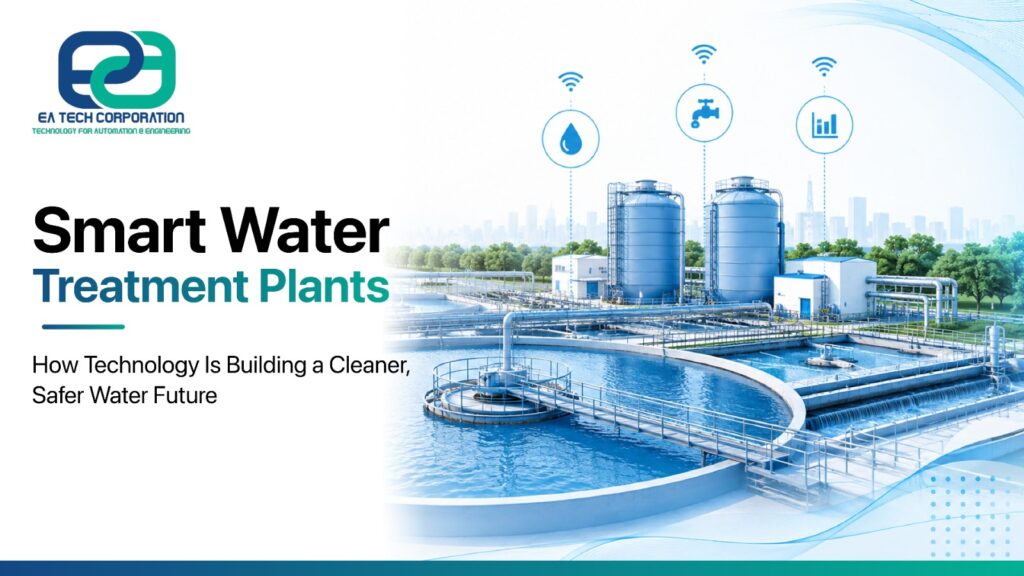
Water is one of the most essential resources for human life, communities, industries, and economic development. As cities expand and industrial activities increase, the demand for clean, safe, and reliable water continues to grow. At the same time, water pollution, changing environmental conditions, rising operational costs, and increasing quality requirements are creating new challenges for organizations responsible for water management.
Modern Water Treatment Plants (WTPs) are evolving to address these challenges. Technology is making water treatment processes more automated, measurable, efficient, and reliable. From WTP automation and PLC control systems to SCADA monitoring, sensors, chemical dosing systems, filtration, pumping, and real-time data monitoring, modern technology is changing how treatment plants operate.
The goal is simple: cleaner water, better process control, improved efficiency, and a safer water future.
What Is a Water Treatment Plant?
A Water Treatment Plant is a facility designed to remove impurities, contaminants, and unwanted substances from water so it can meet the required quality standards for its intended use.
Depending on the application, a treatment plant may use technologies such as filtration, reverse osmosis (RO), UV treatment, softening, clarification, chemical dosing, and disinfection.
Water treatment solutions can serve different requirements, including:
- Municipal Water Treatment Plants
- Industrial Water Treatment Plants
- Commercial Water Treatment Plants
- Drinking water systems
- Process water systems
- Effluent Treatment Plants (ETP)
- Sewage Treatment Plants (STP)
- Industrial RO systems
Modern treatment facilities increasingly combine these physical and chemical treatment processes with automation to improve plant performance.
Why Is WTP Automation Important?
Traditional water treatment operations can depend heavily on manual monitoring and operator intervention. While experienced operators remain essential, manual processes can become challenging when plants operate continuously or involve multiple treatment stages.
WTP Automation integrates technologies such as PLC, SCADA, sensors, and IoT into water treatment processes. This enables operators to monitor important parameters, control equipment, receive alarms, and manage plant operations more efficiently.
Automation can help with:
- Real-time monitoring
- Flow and pressure control
- Chemical dosing
- Pump operation
- Valve control
- Filtration management
- Alarm generation
- Centralized monitoring
- Data collection
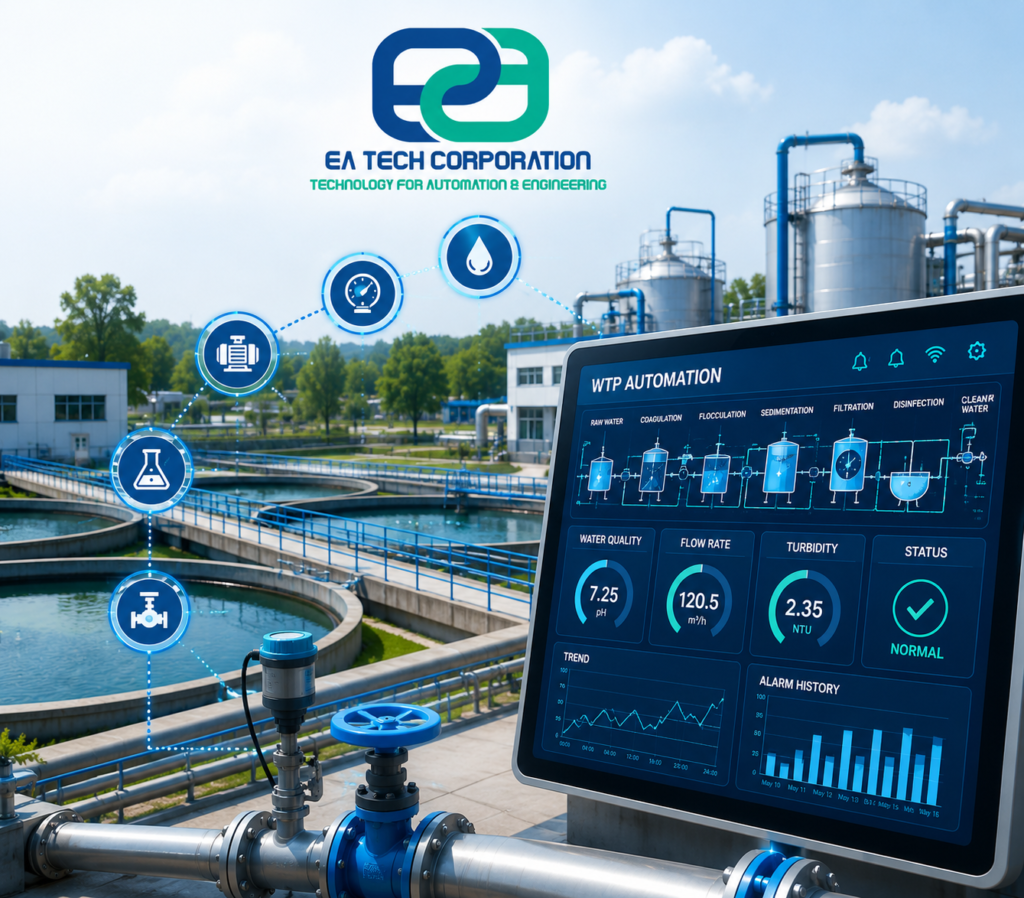
By connecting different components of a plant, water treatment plant automation can transform a manual process into a more organized and responsive system.
The Role of PLC in Water Treatment Plants
A PLC (Programmable Logic Controller) is an important component of modern industrial automation.
In a water treatment plant, PLC systems can control equipment and processes according to programmed operating conditions. Pumps, valves, dosing systems, filtration processes, and other equipment can be coordinated through automated control logic.
For example, a PLC can receive information from sensors and respond according to predefined conditions. This can help maintain consistent operation while reducing unnecessary manual intervention.
A properly designed PLC control system can therefore become the operational foundation of an automated WTP.
SCADA Provides Centralized Monitoring
While PLC systems control processes, SCADA (Supervisory Control and Data Acquisition) provides operators with a centralized interface for monitoring and managing plant operations.
A SCADA system for water treatment can provide information about equipment status, process parameters, alarms, and operational conditions through a centralized dashboard.
This can help operators understand what is happening across the plant without physically inspecting every component.
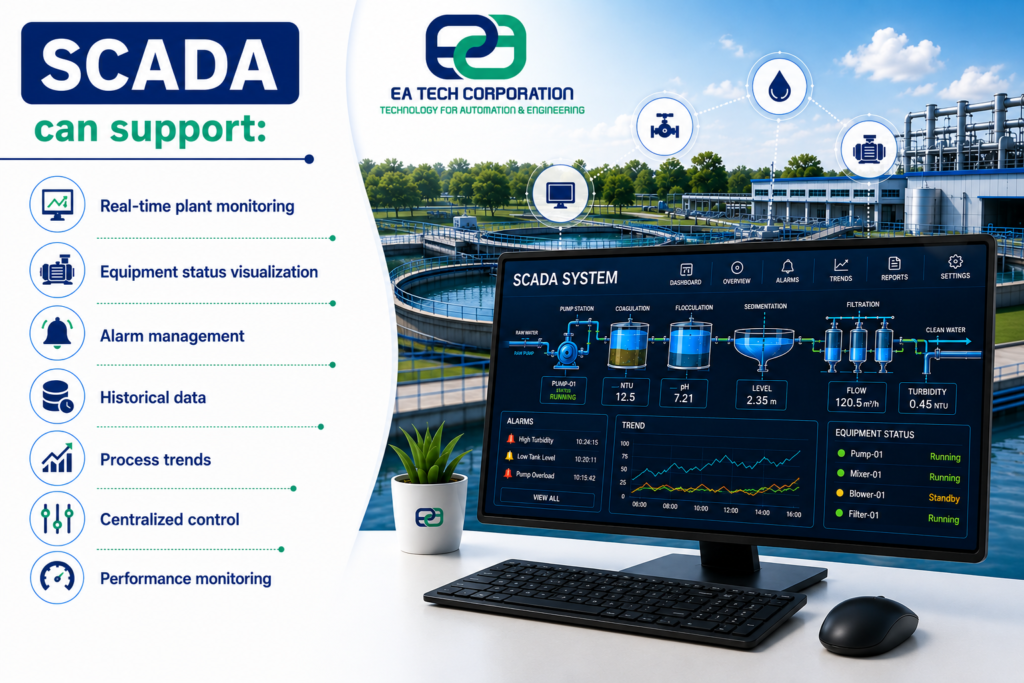
For larger or complex treatment facilities, centralized monitoring can significantly improve operational visibility.
Smart Sensors Improve Water Quality Monitoring
Sensors are another important part of a modern smart water treatment plant.
Depending on the plant design and treatment requirements, sensors and analyzers can monitor parameters such as:
- pH
- Turbidity
- Chlorine
- Flow
- Pressure
- Water level
- Temperature
- Other process parameters
EA Tech Corporation’s product range includes pH analyzers, turbidity analyzers, chlorine analyzers, flow meters, level transmitters, pressure transmitters, and level sensor switches, supporting different water-treatment and automation applications.
Real-time measurements can help operators identify abnormal conditions and take corrective action more quickly.
Automated Chemical Dosing
Chemical dosing is an important stage in many water treatment processes. The correct amount of chemical may depend on water characteristics, treatment requirements, and operating conditions.
A Chemical Dosing System can automate the controlled addition of treatment chemicals.
Automation can help improve consistency and reduce the possibility of excessive or insufficient dosing. When integrated with monitoring and control systems, dosing can be managed as part of a broader automated treatment process.
This can support better process control while helping organizations manage chemical consumption efficiently.
Efficient Pump and Valve Control
Pumps are critical components of water treatment infrastructure. They move water between different treatment stages, storage systems, and distribution points.
Modern pump automation can help coordinate pump operation according to process requirements.
Similarly, automated valves can control the movement of water through different treatment sections.
Technologies such as VFD control panels can also support controlled motor operation where appropriate. EA Tech Corporation provides VFD control panels as part of its automation-related services and also offers pump installation and commissioning.
Efficient pump and valve management can contribute to improved reliability and optimized plant operation.
Applications of Smart Water Treatment Plants
Smart WTP technology is not limited to one type of organization. Different sectors can benefit from automated and digitally monitored treatment systems.
Municipal Water Treatment
Municipal plants are responsible for supplying treated water to communities. Automation can help manage chemical dosing, filtration, pumping, monitoring, and process control more consistently.
Industrial Water Treatment
Manufacturing and process industries often require water with specific quality characteristics. An industrial water treatment plant can help maintain required water quality and support reliable production processes.
Commercial Water Treatment
Hotels, hospitals, offices, institutions, and commercial facilities may require dependable water treatment systems. Automation can reduce operational effort while improving monitoring and reliability.
Wastewater Treatment
Automation is also important for ETP and STP systems. Monitoring and control can help manage treatment processes while supporting environmental compliance and operational efficiency.
EA Tech Corporation highlights water treatment applications involving RO, UV, filtration, softening, ETP, and STP systems.
Benefits of Water Treatment Plant Automation
Implementing WTP Automation can provide several operational benefits.
- Real-Time Monitoring
Operators can monitor plant conditions and equipment status in real time rather than depending entirely on periodic manual checks.
- Reduced Human Error
Automation can reduce repetitive manual operations and provide consistent control according to programmed conditions.
- Better Energy Management
Automated pump and motor control can help organizations optimize equipment operation and energy usage.
- Improved Chemical Management
Automated dosing can help maintain more consistent treatment processes and support efficient chemical usage.
- Faster Fault Detection
Alarm systems can alert operators when process parameters or equipment conditions move outside defined limits.
- Centralized Control
PLC and SCADA integration can provide a centralized view of plant operations.
- Better Operational Data
Recorded process information can help operators and management analyze plant performance and identify areas for improvement.
These benefits make automation an increasingly important part of modern water treatment infrastructure. EA Tech Corporation’s WTP automation offering includes PLC and SCADA integration, automated chemical dosing, monitoring dashboards, panel installation, commissioning, maintenance, and support.
Building More Sustainable Water Treatment Systems
Sustainability is becoming increasingly important in water management.
A modern water treatment plant should not only deliver the required water quality but should also aim for efficient use of energy, chemicals, equipment, and other resources.
Automation can support this objective by providing better visibility into plant performance and helping operators identify unnecessary consumption or inefficient operating conditions.
Smart monitoring can therefore contribute to a more sustainable approach to water treatment.
Choosing the Right Water Treatment Solution
Every water treatment requirement is different. The appropriate system depends on factors such as:
- Source water quality
- Required treated-water quality
- Treatment capacity
- Industrial or municipal application
- Process requirements
- Available infrastructure
- Automation requirements
- Maintenance considerations
A successful project requires more than installing individual equipment. The treatment process, electrical systems, automation, instrumentation, pumps, valves, control panels, and monitoring systems need to work together.
This makes choosing an experienced Water Treatment Plant and WTP Automation solution provider an important part of project planning.
Why Technology Matters in the Future of Water Treatment
The future of water treatment will increasingly depend on automation, instrumentation, centralized monitoring, and intelligent process control.
As water requirements become more complex, treatment plants will need greater visibility and operational efficiency. Technologies such as PLC, SCADA, sensors, IoT, automated dosing, VFD control, and real-time monitoring can help treatment facilities respond to these requirements.
The objective is not technology for its own sake. It is about using technology to make water treatment more reliable, efficient, controlled, and sustainable.
EA Tech Corporation and Smart Water Treatment
EA Tech Corporation focuses on water treatment and automation solutions designed to support industrial, commercial, and municipal requirements. Its services include Water Treatment Plants, WTP Automation, SCADA, PLC panel installation and commissioning, VFD control panels, MCC panels, and pump installation and commissioning.
Its approach combines water treatment requirements with automation and engineering capabilities, helping organizations build systems with better monitoring and process control.
For organizations looking for Water Treatment Plants in India, particularly those requiring automation and integrated control, selecting a solution provider with both treatment and automation capabilities can simplify project execution.
Conclusion
The future of water treatment is becoming smarter.
Modern Water Treatment Plants are moving beyond conventional manual operation toward integrated systems that use automation, PLC, SCADA, sensors, chemical dosing, monitoring, and intelligent control.
These technologies can help improve water quality management, reduce operational effort, optimize resource usage, detect problems earlier, and create more reliable treatment processes.
As demand for safe and sustainable water continues to grow, smart WTP solutions will play an increasingly important role in industries, communities, and commercial facilities.
With the right combination of treatment technology and automation, businesses can move toward a cleaner, safer, and more efficient water future.
EA Tech Corporation is helping advance this future through integrated Water Treatment Plant and WTP Automation solutions designed around modern water-management requirements.
Smart Water Treatment Plants
Powered by PLC & SCADA Automation
EA Tech Corporation delivers advanced Water Treatment Plant, WTP Automation, Industrial RO, ETP, STP, Chemical Dosing, PLC & SCADA solutions for clean, safe and sustainable water.