


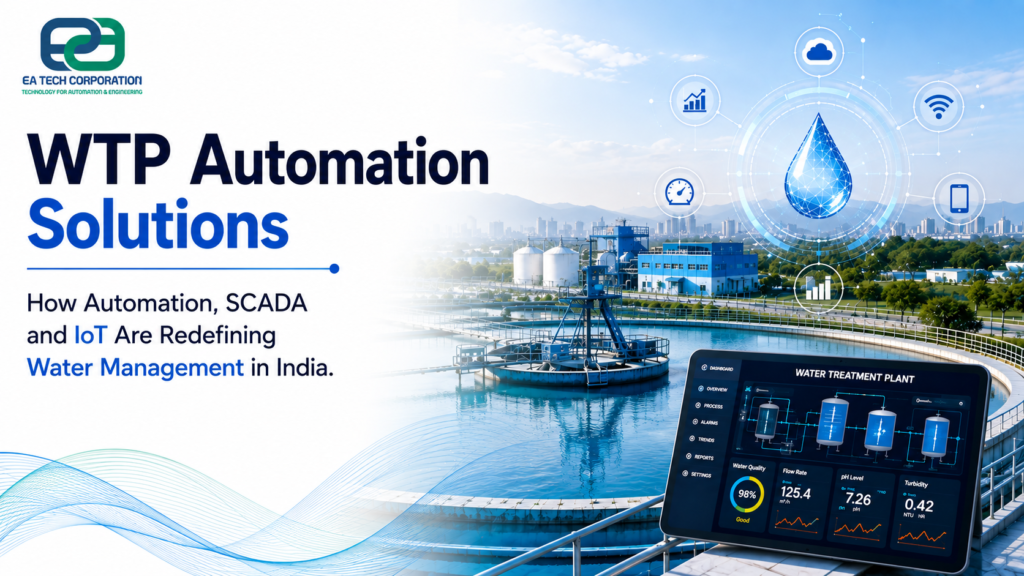
Water is one of the most important resources for communities, industries, commercial facilities, and infrastructure projects. As demand increases and water resources face growing pressure, simply building a treatment plant is no longer enough.
Modern water infrastructure needs to be efficient, measurable, automated, and sustainable.
This is where the concept of a smart water treatment plant becomes important.
Traditional treatment plants often depend heavily on manual monitoring and operator intervention. Modern systems can combine PLC automation, SCADA, sensors, instrumentation, intelligent control panels, and data monitoring to improve operational visibility and consistency.
EA Tech Corporation provides water-treatment and automation solutions, including WTP automation, SCADA, PLC panel installation and commissioning, VFD control panels, MCC panels, pump installation, and related water-treatment technologies.
Why Traditional Water Treatment Operations Are Changing
A conventional water treatment process may involve multiple pumps, valves, chemical dosing systems, filters, tanks, flow meters, pressure instruments, and water-quality monitoring points.
When these systems are operated manually, operators may need to inspect equipment at different locations and record information manually.
This can create challenges such as:
- Delayed fault detection
- Higher manual intervention
- Inconsistent monitoring
- Difficult performance tracking
- Increased operational workload
- Limited historical data
- Slower response to abnormal conditions
A properly designed WTP automation system can connect these components into a centralized operational environment.
What Makes a Water Treatment Plant “Smart”?
A smart WTP is not simply an automated plant.
It is a system where equipment, sensors, controllers, software, and operators work together.
A typical architecture can include:
Sensors → PLC → Control Panels → SCADA → Operator → Data & Decisions
Sensors collect field information.
The PLC processes control logic.
Control panels operate equipment.
SCADA provides visualization and monitoring.
Operators can then respond based on real-time information.
This creates a more connected approach to water management.
PLC: The Control Centre of the Plant
A Programmable Logic Controller (PLC) is one of the most important components of industrial automation.
In a water treatment plant, PLC systems can be configured to control equipment such as:
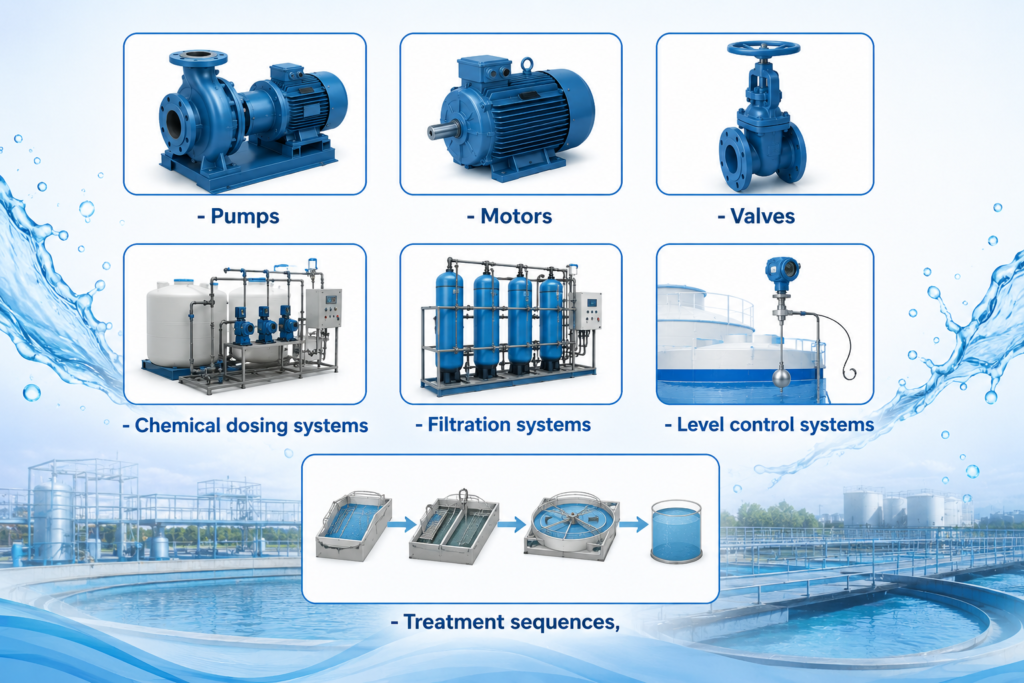
For example, if a storage tank reaches a predefined level, the control logic can respond according to the plant’s configured operating sequence.
This reduces the need for continuous manual switching.
EA Tech Corporation provides PLC panel installation and commissioning as part of its industrial automation services.
SCADA Brings the Plant to One Screen
SCADA automation provides operators with centralized visualization and control.
Instead of physically inspecting every part of the plant, operators can monitor important parameters through a centralized interface.
Depending on the system design, SCADA can display:
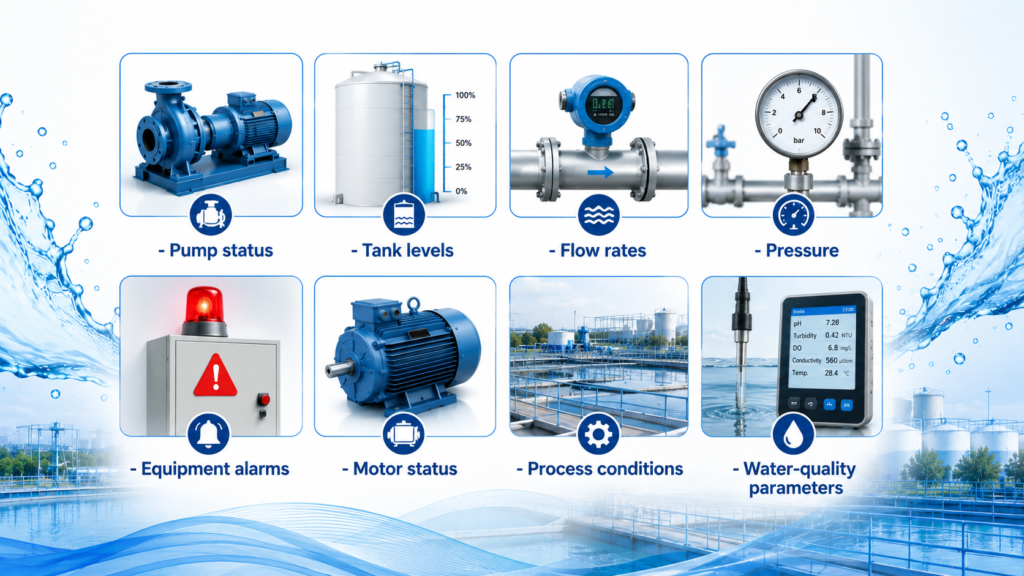
This improves operational visibility.
EA Tech Corporation’s current service portfolio includes SCADA alongside WTP automation and PLC panel installation.
IoT: Turning Water Data into Actionable Information
The next step in water-management technology is the use of IoT-based monitoring.
IoT devices can collect operational information from connected equipment and sensors.
This can help organizations monitor water infrastructure remotely and build historical datasets.
Imagine a water-treatment operator receiving information about:
Flow + Pressure + Level + Pump Status + Water Quality
from a centralized platform.
Instead of relying only on periodic manual inspection, decision-makers can have access to more continuous operational information.
This creates opportunities for predictive maintenance, performance analysis, resource optimization, and faster fault response.
Intelligent Chemical Dosing
Chemical dosing is another area where automation can provide significant value.
Incorrect dosing can result in poor treatment performance or unnecessary chemical consumption.
A properly engineered automated chemical dosing system can help maintain controlled dosing based on defined process requirements.
EA Tech Corporation also lists chemical dosing systems, chlorinators, chlorine analyzers, pH analyzers, and turbidity analyzers within its water-treatment product portfolio.
The combination of measurement and controlled dosing can support more consistent treatment operations.
Energy Efficiency Through VFD Technology
Pumps and motors can represent a significant portion of the energy consumption of a water-treatment facility.
A Variable Frequency Drive (VFD) allows motor speed to be controlled according to operational requirements.
Instead of always running a pump at full speed, the system can be configured to operate according to process demand.
Potential benefits include:
- Better motor control
- Reduced mechanical stress
- Improved process control
- Potential energy savings
- Smoother equipment operation
EA Tech Corporation provides VFD control panel solutions as part of its automation services.
Water Quality Monitoring Is Becoming More Intelligent
Water treatment is ultimately about achieving the required water quality.
Modern plants can integrate instruments such as:
- pH analyzers
- Turbidity analyzers
- Chlorine analyzers
- Pressure transmitters
- Level sensors
- Flow meters
These instruments provide information that can be used by automation systems.
EA Tech’s product portfolio includes these types of measurement and control devices.
The innovative approach is to connect these measurements rather than treating every instrument as an isolated device.
The Future: Digital Twin and Predictive Water Management
The next stage of smart water infrastructure could involve creating a digital representation of the treatment plant.
Such a system could combine historical and real-time information to help operators understand:
- Equipment performance
- Water consumption
- Energy usage
- Maintenance patterns
- Process efficiency
- Abnormal operating conditions
With AI and analytics added to this infrastructure, businesses and utilities could move toward predictive water management.
Instead of asking:
“What went wrong?”
the objective becomes:
“What is likely to go wrong, and how can we prevent it?”
That is a major shift in industrial water management.
Why Choose an Integrated WTP Automation Approach?
A water-treatment plant should not be viewed as a collection of independent machines.
The strongest solutions connect:
Treatment Equipment + Instrumentation + PLC + SCADA + Electrical Panels + Pumps + Data
EA Tech Corporation has worked on WTP automation projects, including Balangir/Titilagarh, Bhawanipatna/Sagada, and Junagarh, according to its published project portfolio.
This experience highlights the importance of combining water-treatment engineering with automation expertise.
Conclusion
The future of water infrastructure is moving toward smart, automated, connected, and data-driven treatment systems.
A modern Smart Water Treatment Plant can combine PLC automation, SCADA monitoring, instrumentation, VFD control, chemical dosing, and IoT technologies to create better operational visibility and more efficient management.
For municipalities, industries, commercial facilities, and infrastructure projects, the objective should not simply be to treat water.
It should be to build a system that can measure, control, optimize, and continuously improve the entire treatment process.
EA Tech Corporation combines water-treatment expertise with industrial automation to help organizations move toward smarter and more sustainable water management.
Smarter Water Management Starts Here
Discover advanced solutions for modern water treatment, automation, monitoring, and intelligent plant management.