


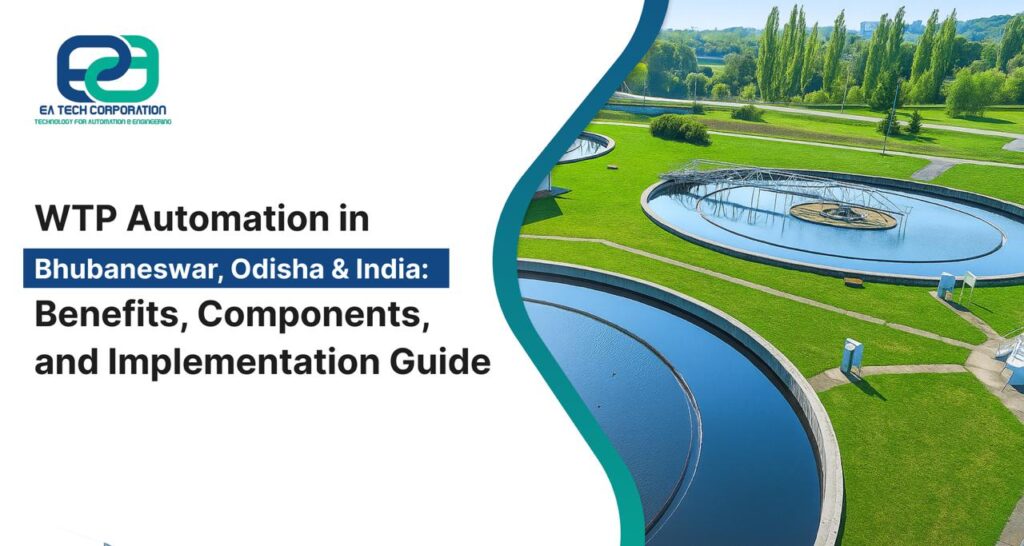
The safe water demand continues to rise day by day, all thanks to multiple factors such as rapid urbanisation, industrial growth, and population expansion. This has made efficient water management a national priority in India. While traditional water treatment systems rely heavily on manual monitoring and control, EA Tech Corporation’s WTP Automation in India is integrating intelligent control systems, sensors, and digital monitoring technologies, which enable businesses to operate efficiently, reduce operational risks, and enhance treatment quality.
Key Components of Water Treatment Plant Automation
For Automated WTP Systems in India, key components include:
- Programmable Logic Controllers (PLC): Automatic control of pumps, valves, and dosing systems.
- SCADA Systems: Enable centralised monitoring, remote operation, and data visualisation.
- Sensors and Instrumentation: pH, turbidity, flow rate, and chemical level monitoring in real time.
- IoT and Data Analytics Platforms: Support predictive maintenance and performance optimisation.
- Alarm and Safety Systems: Prevention of operational failures through trigger alerts.
Benefits of Water Treatment Plant Automation
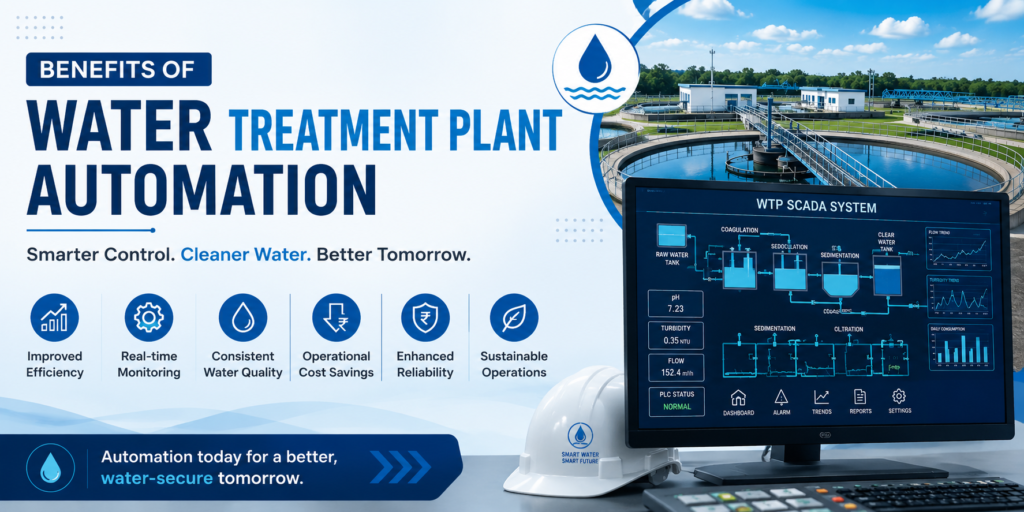
Using Smart WTP Control Solutions in India definitely comes with its own benefits. Some of them are:
- Improved Efficiency: Less manual intervention ensures consistent process control.
- Better Water Quality: Continuous monitoring combined with accurate treatment and regulatory compliance ensures enhanced water quality.
- Reduced Operational Costs: Cut costs through optimised chemical dosing and energy usage.
- Real-Time Monitoring: Quicker response to system issues with the help of remote supervision.
- Enhanced Safety: Prioritise health by reducing human exposure to hazardous chemicals and equipment.
- Reliable Data and Reporting: Simplify regulatory compliance and performance tracking with automated logging.
- Local on-site support: If you’re from Odisha, look for WTP Automation in Odisha to get on-site support quickly, and that too in your local language.
Challenges and Their Solutions
Although WTP Automation in India provides multiple benefits, it also comes with its own set of challenges that can be tricky to deal with. Here’s a list of some of those challenges and how to tackle them.
Challenges and Their Solutions
| Challenge | Solution |
|---|---|
| High Initial Investment | EA Tech Corporation helps implement automation in phases, making the process more budget-friendly. |
| Lack of Skilled Workforce | Partner with Automated WTP Systems in India that provide employee training for better system handling. |
| Sensor Maintenance Requirements | Schedule regular preventive maintenance to ensure consistent performance. |
| Cybersecurity Risks | Secure networks and perform regular software updates to prevent threats. |
| Integration with Legacy Infrastructure | Choose modular and compatible automation platforms for easy integration. |
Implementation Guide for WTP Automation
Implementing Automated WTP Systems in India requires utmost attention, as it involves some intricate processes, such as:
- Assess Plant Requirements: Look for inefficiencies, compliance needs, and automation goals.
- Select Automation Technologies: Select PLC, SCADA, sensors, and communication systems that suit your plant scale.
- System Design and Integration: Develop control architecture and connect with existing infrastructure.
- Installation and Testing: Deploy equipment and conduct performance validation.
- Training and Optimisation: Provide proper training to operators and monitor system performance regularly.
Water Sector Statistics in India
- According to Downtoearth, over 72,000 million litres per day of sewage are generated in India, but only about 28–30% are actually treated.
- India is officially classified as a water-stressed country, with per capita water availability below 1,500 cubic meters annually, as per IndiaSpend.
- IndiaSpend reports that around 163 million people lack access to safe drinking water.
These stats on India’s water and wastewater landscape show the need for automation and how we, as a society, need it more than ever.
Conclusion
The need for safe water has now been elevated. Automated WTP Systems in India are the only way moving forward. They have now become a necessity rather than a luxury as the demand for sustainable, cost-effective, and safe water supplies starts to rise. India needs to look at the future of water and make sure every household receives clean drinking water, as water is the essence of life, and a life without clean water is unsustainable.
FAQs
- It is the use of digital control systems, sensors, and software that automatically monitor and manage water treatment processes with very little manual intervention.
PLCs, SCADA systems, IoT sensors, data analytics platforms, and automated alarm systems are some of the technologies used.
It helps improve efficiency, provides consistent water quality, minimizes operational costs, and helps meet environmental and safety regulations.